The main points
- The green sea turtle, and a culturally significant animal here rather than merely a common one.
- They use this structure regularly, which is why sightings are common.
- Any operator guaranteeing wildlife is telling you something untrue.
- Law keeps people at a distance. A submarine keeps itself at one anyway.
What honu are
The green sea turtle is the large, blunt-headed, olive-and-brown turtle of tropical and subtropical seas, and in Hawaii it is called honu. The name matters: this is an animal with a place in Hawaiian culture rather than simply an item on a wildlife list, and it appears throughout Hawaiian art, story and family tradition.
Adults are substantial. A mature green turtle is a metre or more of shell and can weigh well over a hundred kilograms, which is considerably larger than most people's mental image and is immediately obvious when one appears beside a viewport.
The name is misleading, incidentally. The green refers to the colour of the fat under the shell rather than to the animal, which is generally brown and olive on top and pale below.
Why they are at this site
Green turtles are unusual among sea turtles in that adults are largely herbivorous, grazing algae and seagrass. That diet ties them to particular places: they need somewhere to feed, and they return to it.
Structure helps them in two ways. Hard surfaces grow algae, which is food, and structure provides shelter, which is where a turtle rests. Green turtles spend a great deal of their time doing nothing in particular, tucked under an overhang or on a ledge, and an artificial reef supplies exactly that.
They also use sites like this for cleaning: certain fish species pick algae and parasites off a turtle's shell and skin, and turtles will hold station at a cleaning spot and wait their turn. If you see a stationary turtle with small fish working over it, that is what is happening.
The consequence for a visitor is a good one. These are not animals passing through on migration; they are residents with a reason to be here.
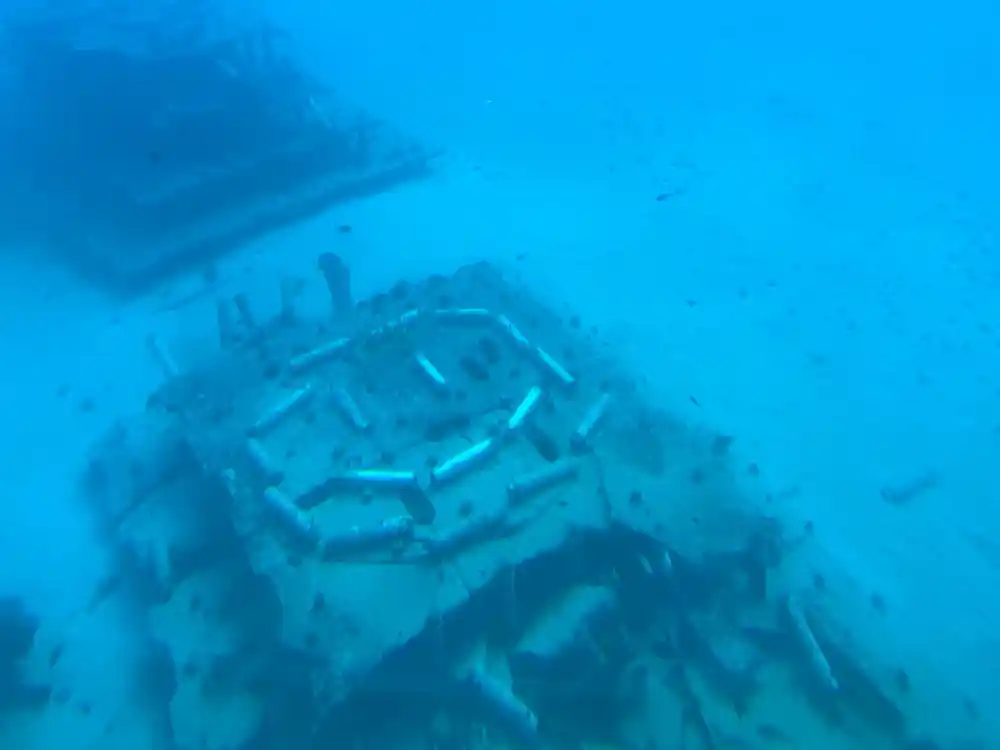
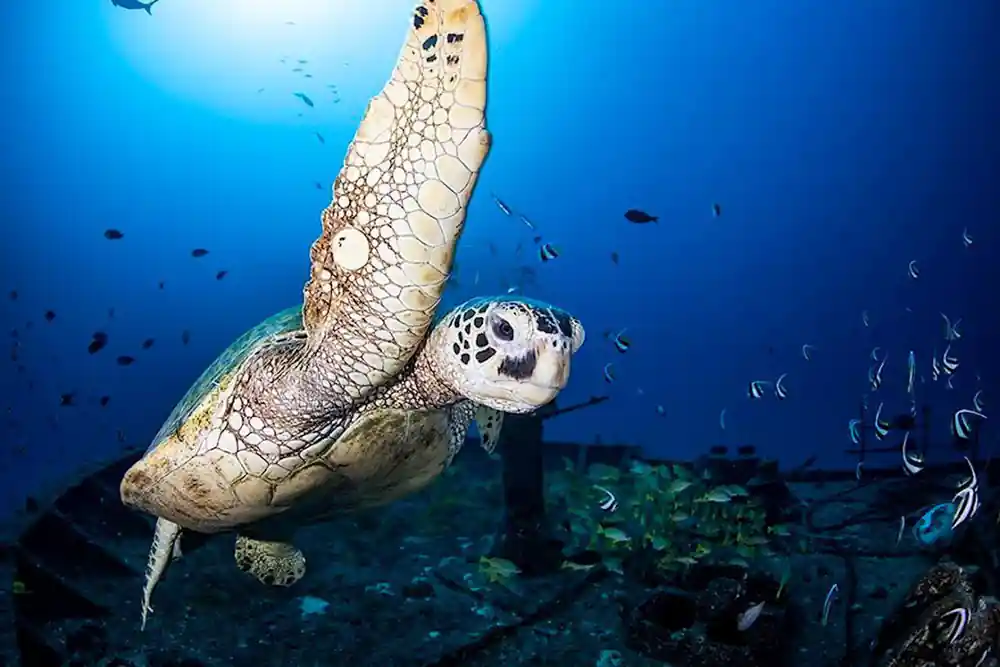
A green sea turtle above the reef structure
How likely you are to see one
Commonly, and not certainly, and it is worth being precise about the difference.
Green turtles are seen on a large share of dives at this site. The pilots know where they tend to be and the route takes account of it. Passengers who see one usually see it well, at close range and unhurried, because a turtle has no particular reason to leave.
But nothing about wildlife is a guarantee, and an operator who promises one is promising something they do not control. Some dives have several. A few have none.
The honest way to book this is to treat a turtle as a very likely bonus rather than as the product. The wrecks and the fish are there every time.
A recovery worth knowing about
The Hawaiian green turtle population is one of the better conservation stories in the Pacific, and it is relevant to what you are looking at through the glass.
Through the middle of the twentieth century the animals were heavily exploited and the population fell to a small fraction of what it had been. Legal protection from the 1970s onwards, combined with the protection of the nesting beaches, reversed that. Numbers have climbed substantially over the decades since, to the point where honu are now a routine sight along Oahu's coast rather than a rarity.
That is why a submarine can reasonably expect to find one at a small artificial reef off a city beach. It would not have been a reasonable expectation fifty years ago.
It also explains the strictness of the rules. A recovery achieved by leaving animals alone is maintained the same way, which is why the distance regulations are enforced rather than advisory.
Honu
The Hawaiian name for the green sea turtle. Resident at this site, protected by state and federal law, and entirely unbothered by a passing submarine.
The rules, and why a submarine sidesteps them
Green sea turtles are protected under United States federal law and under Hawaii state law. Approaching, touching, harassing or feeding them is prohibited, and the rules exist because the population came close to being lost and has recovered substantially under exactly this kind of protection.
In practice this means that on a snorkel or dive there are minimum distances you are expected to keep, and a good operator enforces them.
A submarine is in an unusual position here. It is large, slow, predictable and entirely uninterested in the turtle, and it does not approach: it passes. Turtles read it as terrain rather than as a threat, which is why they so often carry on doing whatever they were doing while sixty-four people look at them.
It is one of the few situations in wildlife tourism where the vehicle is genuinely less intrusive than a person would be.
What to do when one appears
Look at it. This sounds like nothing and it is the whole advice.
A turtle at a viewport is the single best thing that happens on this dive and it lasts a short time. The overwhelming instinct is to photograph it, and photographs through glass at depth in blue light are almost always disappointing compared with the memory.
If you do photograph it, put the lens against the glass to kill the reflection of the cabin, hold still, and take two frames rather than twenty.
And notice the details while you can: the pattern of the shell plates, which is individual to that animal; the barnacles and algae growing on it; the fact that it is breathing air like you are and will have to go up for it eventually. A green turtle can rest submerged for hours, which is why one at a hundred feet is entirely relaxed and you are the one in the machine.
Resident turtles, commonly seen, never promised
from US$168Reserve now & pay later